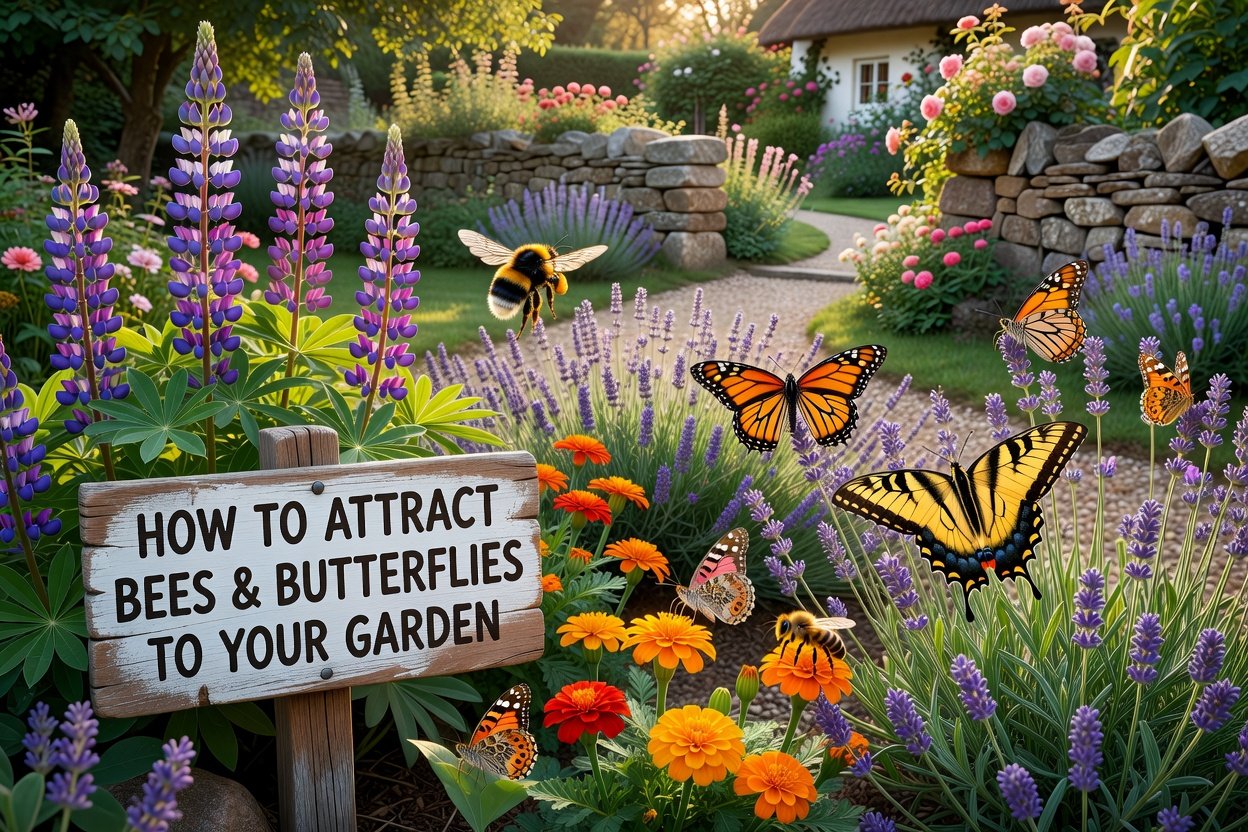
If you want more bees and butterflies in your garden, start with flowers. Then go a step further. The gardens that attract the most pollinators don’t just look pretty for two weeks in June; they offer food, shelter and nesting places across the year.
This guide is for UK gardeners with borders, lawns, patios, balconies, veg patches or small back gardens. You don’t need a meadow. You don’t even need a huge space. A few well-chosen plants in the right place can bring in bumblebees, solitary bees, hoverflies, moths and butterflies.
What you’ll get here is a practical plan: which plants to grow, what to stop doing, how to make the garden safer for insects, and why a slightly less tidy garden is often the better one.
Start With Nectar and Pollen
Bees and butterflies visit gardens mainly for food. Bees need nectar for energy and pollen for protein. Butterflies drink nectar, but their caterpillars also need specific food plants.
That second part gets missed. A garden full of nectar-rich flowers may attract adult butterflies, but it won’t necessarily help them breed. If you want more butterflies long term, you need plants for caterpillars too.
For bees, aim for simple, open flowers where the pollen and nectar are easy to reach. Single flowers are usually better than highly bred double flowers, because many double varieties have extra petals where the useful parts of the flower should be.
The surprise is that some of the most useful pollinator plants aren’t rare or expensive. Lavender, thyme, borage, foxgloves, marjoram, comfrey, sedum and ivy can all be excellent in the right spot.
Choose Plants That Flower Across the Year
The best bee garden has something in flower from late winter to autumn. Early and late food matters because insects can struggle when gardens are bare.
In late winter and early spring, crocus, snowdrops, winter honeysuckle, hellebores, lungwort and pussy willow can help early bumblebees. In spring and early summer, try foxgloves, alliums, hardy geraniums, aquilegia, chives and fruit blossom.
High summer is usually easier. Lavender, catmint, thyme, marjoram, borage, verbena, cosmos, echinacea, scabious and salvias can all be busy with bees and butterflies. For late food, sedum, asters, single dahlias, Japanese anemones and ivy are useful.
Ivy deserves a special mention. It flowers late, often in September and October, and it can be buzzing when almost everything else has finished. Don’t rip it all out unless it’s causing a real problem.
Quick Planting Guide for Bees and Butterflies
Use this as a starting point rather than a shopping list. Pick plants that suit your soil, light and space.
| Garden situation | Best plant choices | Why they work |
|---|---|---|
| Sunny border | Lavender, catmint, salvias, verbena, scabious | Long-flowering and easy for insects to use |
| Shady or part-shady border | Foxgloves, lungwort, hardy geraniums, hellebores | Good for early and sheltered feeding |
| Patio pots | Thyme, chives, borage, dwarf buddleja, cosmos | Good nectar in a small space |
| Wildlife corner | Nettles, long grass, ivy, bramble | Food and shelter, especially for caterpillars |
| Vegetable garden | Chives, calendula, borage, nasturtiums, poached egg plant | Helps pollinators and looks at home near crops |
| Late-season gap | Sedum, asters, ivy, single dahlias | Feeds insects when summer flowers fade |
If you only do one thing, plant for the gaps. Most gardens already have some summer flowers. Early spring and autumn are where pollinators often need more help.
Grow Caterpillar Food Plants Too
Butterflies need nectar, but caterpillars need leaves. That means you may have to tolerate some chewing.
Nettles are the classic example. Small tortoiseshell, peacock, red admiral and comma butterflies all use nettles as caterpillar food plants. The catch is that they prefer nettles in warm, sunny, sheltered spots, not one miserable stem behind the bins.
Holly and ivy can support holly blue butterflies. Long grass helps several species. Garlic mustard can be used by orange-tip butterflies. Buckthorn and alder buckthorn are linked with brimstone butterflies.
This is the high-friction reality: a butterfly-friendly garden is not always spotless. If every caterpillar is removed and every patch of nettle is cleared, you’ll still get passing butterflies, but fewer will complete their life cycle in your garden.
You don’t need to let nettles take over. A contained patch in a sunny corner is enough to start.
Stop Using Pesticides Where You Can
If you want more bees and butterflies, avoid insecticides. It sounds obvious, but many “bug killer” sprays don’t just target the insect you dislike.
Aphids, caterpillars and other insects are part of the food chain. Blue tits, ladybirds, lacewings, hoverflies and parasitic wasps all rely on them. If you spray every outbreak, the garden becomes less useful for wildlife.
For aphids, try a strong jet of water, hand-squashing small colonies, or simply waiting a few days to see whether predators arrive. On healthy plants, a small aphid population is often not a disaster.
Slug pellets, weedkillers and lawn treatments can also affect how wildlife uses the garden. If you do use any garden product, read the label carefully and use it only where needed. More is not better.
Make a Sunny, Sheltered Feeding Spot
Bees and butterflies like warmth. A sunny, sheltered border will usually get more visitors than a cold, windy corner.
South-facing and west-facing spots are especially useful. Plant nectar-rich flowers near a wall, fence or hedge where insects can feed without being battered by wind. Butterflies often bask on warm stones, gravel paths, fences and bare soil.
Group plants together rather than dotting single plants around the garden. A clump of lavender or marjoram is easier for insects to find than one lonely plant squeezed between shrubs.
This doesn’t mean every plant has to be in full sun. Shade has value too. But if your main aim is to attract butterflies, give them warm places to feed and rest.
Add Water and Safe Landing Places
Pollinators need water, especially in warm weather. A shallow dish can help, but make it safe.
Use a plant saucer, shallow bowl or old dish with pebbles, stones or marbles in it so insects can land without drowning. Keep the water clean and top it up during dry spells.
A wildlife pond is even better if you have space, but it needs shallow edges or stones for safe access. Bees will also drink from damp soil, moss and pond margins.
Butterflies sometimes gather on damp ground to take in moisture and minerals. A small patch of damp sand or soil in a sunny spot can be useful. It doesn’t have to look fancy.
Leave Some Places Untidy
A perfectly neat garden is often a poor home for insects. Many bees and butterflies need quiet places to nest, hide or overwinter.
Leave some hollow stems standing through winter, especially from plants like teasel, fennel, alliums and herbaceous perennials. Solitary bees and other insects may use stems and crevices. Cutting everything down in autumn removes shelter just when it’s needed.
A small log pile, leaf litter under shrubs, long grass at the edge of a lawn, or a patch of bare sunny soil can all help. Ground-nesting bees need undisturbed soil, so don’t mulch every inch of the garden.
You can still keep the garden looking cared for. The trick is to make deliberate messy areas: a log pile behind shrubs, a long grass strip along a fence, a nettle patch in a corner. Controlled untidiness works.
Be Careful With “Pollinator-Friendly” Labels
Garden centres are full of plants labelled as good for bees and butterflies. Many are useful, but the label doesn’t tell you everything.
Check the flower shape. Can you see the centre of the flower? Can an insect actually reach it? Open, single flowers are often better than dense, double blooms.
Also think about how long the plant flowers. A plant that feeds bees for eight weeks is usually more valuable than one that looks amazing for six days. Long-flowering herbs such as thyme, marjoram, chives and lavender earn their space.
If you buy bedding plants, avoid anything that looks too perfect and has no insect activity around it on a warm day. That’s not a scientific test, but it’s a useful clue.
Plants to Avoid Letting Take Over
Some plants are excellent for pollinators but can become too vigorous in small gardens. Buddleja is loved by butterflies, but full-sized types can get large and woody if never pruned.
Comfrey is brilliant for bees, but it spreads and self-seeds in some gardens. Borage is easy and popular with bees, but it will pop up again if allowed to seed. Ivy is valuable, but it needs managing near gutters, fences and weak structures.
None of this means “don’t grow them”. It means grow them with your eyes open. Choose compact varieties where space is tight, cut back at the right time, and remove seedlings if they appear where you don’t want them.
Most wildlife gardening problems come from good plants in the wrong place.
A Simple Plan for a Small Garden
For a small UK garden, don’t overcomplicate it. Choose one early flower, three summer flowers, one late flower and one caterpillar plant.
A simple mix could be crocus, foxglove, lavender, marjoram, verbena, sedum and a small nettle patch. Add chives or thyme in pots if you have a patio. If you have a fence, allow some ivy to flower where it’s safe to do so.
For butterflies, add warmth and shelter. A sunny border with nectar plants will always do better than a windswept lawn with one buddleja stuck in the middle.
For bees, think variety. Different bees have different tongue lengths and feeding habits, so a mix of flower shapes helps more species.
What to Do Next
Next 10 minutes: walk around your garden and note when it has flowers. Look for gaps in early spring and autumn, not just summer.
Today: choose three pollinator plants that suit your conditions. For a sunny spot, lavender, marjoram and sedum are a strong start. For part shade, try lungwort, foxgloves and hardy geraniums.
This week: stop using insecticides where you can, leave one small untidy area, and add a shallow water dish with stones for safe landing.
Attracting bees and butterflies isn’t about buying one magic plant. It’s about making the garden useful for longer: nectar, pollen, caterpillar food, shelter, water and fewer chemicals. Do that, and the garden won’t just have more insects passing through. It will start to support them properly.