A good climbing plant can turn a plain fence or bare wall into one of the best-looking parts of the garden. A bad choice can do the opposite. It can swamp a shed, pull at weak trellis, creep into gutters, or sit there sulking because the spot is too shady, dry or exposed.
This guide is for UK gardeners who want climbers that actually suit their space. Fences, walls and pergolas all behave differently, so the best plant depends on light, support, soil, final size and how much pruning you’re willing to do.
The short version? Match the climber to the structure first, then choose the flower colour.
Start With the Support, Not the Plant
Climbing plants don’t all climb in the same way. Some twine around supports, some cling to walls, and others need tying in. This matters more than people think.
Clematis, honeysuckle, jasmine and wisteria need something to hold onto, such as wires, trellis, arches or pergola beams. Climbing roses don’t really climb by themselves at all. They make long stems that need tying to a support.
Ivy, climbing hydrangea and Virginia creeper can cling to walls without much help. That sounds convenient, but only use them on sound brickwork or masonry. If mortar is already loose, a self-clinging climber may make maintenance harder.
Before buying, ask one dull but useful question: “How will this plant physically stay up?” It will save you trouble later.
Quick Guide: Which Climber Suits Your Space?
Use this as a starting point before heading to the garden centre. The right plant in the right place is much easier than constant pruning and apologising to the neighbour.
| Garden situation | Best climbing plants | Why they work |
|---|---|---|
| Sunny fence | Clematis, climbing rose, star jasmine, passionflower | Plenty of flowers, good use of vertical space |
| Shady wall | Climbing hydrangea, ivy, some honeysuckles | Better tolerance of lower light |
| Pergola | Wisteria, grapevine, climbing rose, jasmine | Strong structure supports heavier growth |
| Narrow side return | Clematis, annual sweet peas, compact jasmine | Easier to keep slim |
| Wildlife-friendly boundary | Honeysuckle, ivy, climbing rose, pyracantha | Flowers, berries, shelter and nesting cover |
| Evergreen screening | Star jasmine, ivy, evergreen clematis | Year-round cover where conditions suit |
| Large bare wall | Climbing hydrangea, Virginia creeper, wisteria | Enough scale to cover bigger areas |
If you only have a lightweight fence panel, don’t plant something that wants to become a garden monster. Wisteria, mature ivy and large rambling roses need serious support.
Clematis: The Most Flexible Choice
Clematis is one of the best climbing plants for fences, walls and pergolas because there’s a type for almost every style of garden. Some flower in spring, some in summer, and some go on into early autumn.
For beginners, later-flowering clematis are often easier. Many are pruned hard in late winter or early spring, which keeps things simple. Popular choices include ‘Étoile Violette’, ‘Polish Spirit’, ‘Jackmanii’ and ‘Princess Diana’.
Clematis likes its roots cool and its top growth in the light. That old advice is still useful. Plant it deeply, water it well in the first year, and mulch the base with compost, bark or low planting.
The high-friction reality is that clematis hates drying out in its first season. A young plant on a hot fence can fail quickly if it’s left to fend for itself through a dry spell.
Climbing Roses: Best for Romance, Scent and Structure
A climbing rose can make a fence, arch or pergola look settled and generous. It’s hard to beat for scent and repeat flowering.
Choose carefully, though. Climbing roses and rambling roses are not the same. Climbers are usually easier to manage in smaller gardens and often repeat flower. Ramblers can be magnificent, but many grow once, flower once, then send long stems everywhere.
Good climbing roses for UK gardens include ‘Gertrude Jekyll’, ‘The Generous Gardener’, ‘Claire Austin’, ‘New Dawn’ and ‘Dublin Bay’. Always check final height before buying. Some roses labelled as climbers still get much bigger than expected.
Tie the main stems as horizontally as you can. This is the non-obvious trick. Horizontal stems produce more flowering side shoots, so a rose trained across a fence often flowers better than one allowed to shoot straight upwards.
Honeysuckle: Brilliant for Wildlife
Honeysuckle earns its place in a British garden. It has scented flowers, a loose natural habit, and real wildlife value. Bees, moths and birds all use it.
It suits fences, arches, obelisks and informal pergolas. Native honeysuckle, Lonicera periclymenum, is especially good for wildlife, while garden varieties can offer stronger colour or longer flowering.
Honeysuckle likes fertile, moisture-retentive soil. It can cope with some shade, but flowering is usually better with sun on the top growth. If the base gets dry and starved beside a fence, it may become woody and thin.
Give it support from the start. Honeysuckle twines, so wires or trellis work well. Left unsupported, it becomes a tangled shrub rather than a useful climber.
Star Jasmine: Evergreen Cover With Summer Scent
Star jasmine, Trachelospermum jasminoides, is a smart choice for sheltered UK gardens. It has glossy evergreen leaves, scented white flowers in summer, and often turns bronze in colder weather.
It’s especially good on a sunny, sheltered fence or wall. In milder areas, it can make excellent year-round screening. In colder or exposed gardens, it may struggle, so position matters.
Star jasmine is not a true jasmine, but gardeners usually forgive it because it behaves so well. It grows steadily rather than violently, and it can be clipped to shape after flowering.
It does need tying in at first. Don’t plant it against a blank fence and expect it to know what to do. Add wires or trellis, then guide the stems as they grow.
Wisteria: Beautiful, But Not for Weak Structures
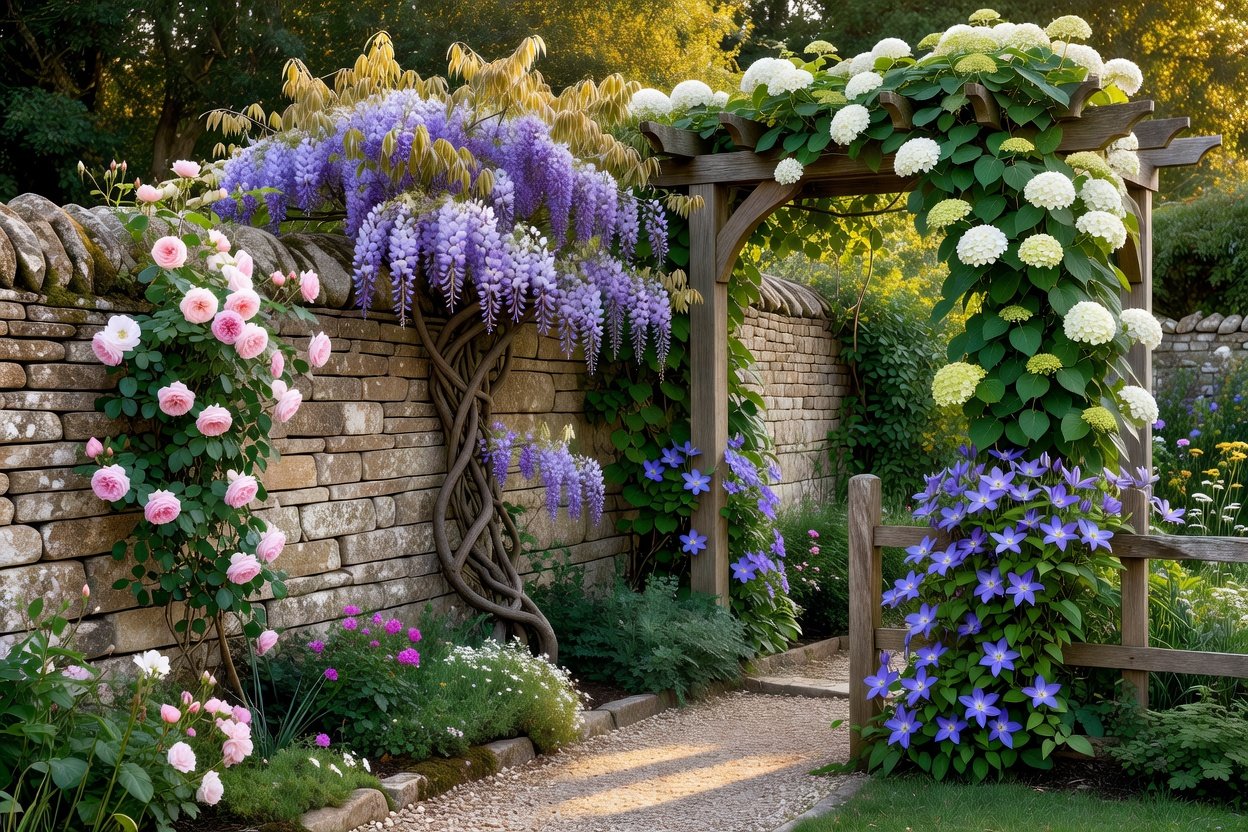
Wisteria is stunning on a pergola or house wall when it’s happy. The hanging flowers in late spring are enough to make people stop and stare.
It is also heavy, vigorous and long-lived. This is not a plant for a flimsy fence panel or a wobbly arch from a bargain aisle. It needs strong posts, beams, wires or properly fixed wall supports.
Wisteria also needs pruning twice a year, usually in summer and winter. That pruning keeps growth under control and encourages flowering spurs. Skip it for a few years and you’ll have a leafy tangle instead of a graceful display.
For most small gardens, I’d only choose wisteria if the structure is strong and the gardener is happy to prune. If that sounds like a chore, pick clematis or climbing rose instead.
Climbing Hydrangea: The Shady Wall Specialist
Climbing hydrangea, Hydrangea anomala subsp. petiolaris, is one of the best choices for a shady wall. It clings by aerial roots and produces white lacecap flowers in late spring or early summer.
It is slow to start. Very slow, sometimes. Then, once established, it grows with much more confidence. This can fool beginners into thinking it has failed.
Climbing hydrangea is useful on north-facing or east-facing walls where many flowering climbers sulk. It likes moisture-retentive soil and a cool root run.
It is not the best choice for a lightweight fence because mature plants become heavy. Use it where the wall is sound and there is room for it to mature.
Ivy: Better Than Its Reputation, If Managed
Ivy gets blamed for all sorts of garden crimes. Some of that is fair. Some isn’t.
On sound walls, ivy can be useful for evergreen cover, nesting birds, late-season flowers and winter berries. Its autumn flowers are valuable for pollinators, especially when little else is available. Birds also shelter and feed in mature ivy.
The problem comes when ivy is planted in the wrong place or ignored for years. It can get heavy, creep under roof tiles, block gutters and hide damaged brickwork. On weak fences, it can add too much weight.
If you use ivy, manage it. Clip it back from windows, gutters, roofs and neighbouring plants. A controlled patch of ivy is useful. A neglected wall of it can become a job.
Passionflower: Exotic Looks, But Give It Shelter
Passionflower looks far too tropical to work in a British garden, but Passiflora caerulea often does well in milder areas. The flowers are extraordinary, and orange fruits may follow in warm seasons.
It likes a sunny, sheltered wall or fence. Cold winds and hard frost can damage it, especially when young. In colder parts of the UK, it’s more of a gamble.
Passionflower grows fast once it gets going. That can be helpful if you want quick cover, but it also means pruning may be needed to keep it in bounds.
If you garden near the coast or in a mild city garden, it’s worth considering. If your plot is exposed and frosty, choose something hardier.
Annual Climbers for Quick Results
Not every climber has to be permanent. Annual climbers are useful while slower plants establish, or when you want colour for one season.
Sweet peas are the classic choice. They’re ideal for obelisks, netting, wigwams and sunny fences, and the scent is hard to beat. Sow in autumn or spring, give them rich soil, and keep picking the flowers to encourage more.
Nasturtiums are easy, cheerful and good in poorer soil. They can scramble through trellis or over low fences, though they’re not neat. Morning glory can be lovely in a warm spot, but it needs enough sun and a decent summer.
Annuals are also good for renters. You can cover a bare fence for a few months without planting something that becomes someone else’s pruning problem.
Pergolas Need Stronger, Better-Chosen Climbers
Pergolas are different from fences because people sit or walk underneath them. That changes the plant choice.
Avoid anything too thorny where people brush past it. A climbing rose can work beautifully, but train it with care and keep stems tied in. Wisteria, grapevines and jasmine can be excellent if the pergola is strong enough.
Think about mess too. Grapevines drop leaves. Wisteria drops flowers and seed pods. Roses drop petals. None of this is a disaster, but you may not want heavy shedding over a dining table.
For a small pergola, one well-trained climber is often better than three fighting for space. Plants look romantic when mature. They look awful when congested.
Fences Need Lighter Plants Than Walls
Most modern garden fences are not built to carry huge weight. A few wires with clematis is fine. A mature rambling rose plus ivy plus honeysuckle may be asking too much.
Attach supports to fence posts where possible, not just thin panels. Horizontal wires are often better than flimsy trellis, especially for roses and clematis. Leave a gap between plant and fence so air can move.
Also think about ownership. If the fence belongs to your neighbour, don’t attach wires or grow vigorous climbers on it without permission. Awkward conversations over fence damage are best avoided.
For fences, the safest beginner choices are clematis, annual sweet peas, compact honeysuckle, star jasmine in sheltered spots, and smaller climbing roses.
Walls Can Be Dry at the Base
Walls create another problem: rain shadow. The soil right at the base of a wall is often much drier than the soil a metre away.
Plant at least 30–45cm out from the wall where you can, then angle the stems back towards the support. Water deeply during the first year. A quick sprinkle over the surface won’t reach the roots.
South-facing walls can be hot and dry. North-facing walls are cooler and darker. East-facing walls catch morning sun, while west-facing walls get warmer afternoon light. These differences matter.
A plant that fails on one wall might thrive on another. It’s not always your fault.
What to Plant If You Want Privacy
For year-round privacy, choose evergreen climbers. Star jasmine, ivy, evergreen clematis and some forms of honeysuckle can help, depending on the site.
Evergreen clematis, such as Clematis armandii, has attractive leaves and early flowers, but it needs space and shelter. It can become large, so don’t squeeze it into a tiny panel and hope for the best.
For seasonal privacy, deciduous climbers can still work well. Clematis, roses, hops, grapevines and honeysuckle all give good cover during the growing season, just when you’re most likely to be outside.
If privacy is urgent, combine a climber with proper screening rather than expecting a young plant to do the job immediately. Plants take time. Screens work today.
Common Mistakes to Avoid
The first mistake is planting too close to a wall or fence and then forgetting to water. Young climbers dry out quickly in these spots.
The second is choosing a plant by flower alone. Final size, pruning needs and support type matter just as much.
The third is planting vigorous climbers on weak structures. A plant may look harmless in a two-litre pot, but that tells you very little about its adult size.
The fourth is ignoring pruning. Most climbers need some guidance. A few minutes at the right time saves a savage cut-back later.
A Simple Plan for Choosing a Climber
If you’re not sure what to buy, narrow the decision by site.
Next 10 minutes: check the spot. Is it sunny, shady, sheltered, exposed, dry at the base, or next to a weak fence? Be honest.
Today: choose the plant by structure. For a fence, pick clematis, honeysuckle, star jasmine or a smaller climbing rose. For a shady wall, choose climbing hydrangea or ivy. For a strong pergola, consider wisteria, grapevine, jasmine or a rose.
This week: put the support in before planting. Add wires, trellis, an obelisk or strong pergola fixings, then plant slightly away from the base of the structure and water well.
The best climbing plants for fences, walls and pergolas are the ones that fit the job. Clematis gives flexibility, roses bring scent and flowers, honeysuckle helps wildlife, star jasmine gives evergreen polish, and wisteria is wonderful where the support is strong enough. Choose for the site first, and the plant will look as if it was always meant to be there.